Inspector Davis
The Murder of Roger AckroydInspector Davis is the local police officer who responds to Roger Ackroyd’s murder and investigates the case alongside the more methodical Hercule Poirot. His early certainty that the evidence points to Ralph Paton gives the investigation a plausible but mistaken shape; Poirot’s scrutiny of the window, telephone call, and missing Dictaphone exposes the limits of that initial case.
Identity and Introduction
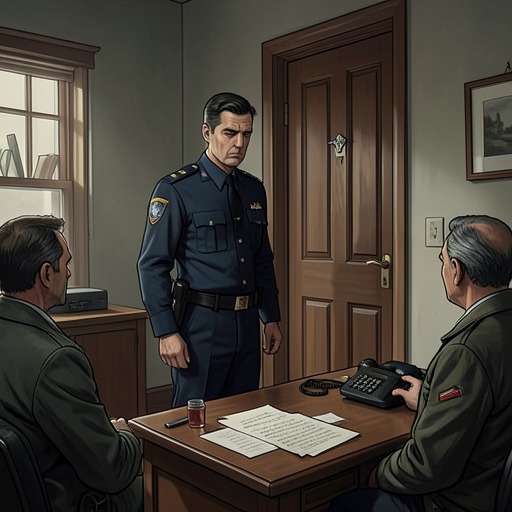
Davis arrives at Fernly Park with a police constable after the household’s alarm is raised. He asks whether Ackroyd’s death might have been accidental or suicidal, and Dr. James Sheppard rules out both possibilities. Davis accepts that the death is murder and begins the police inquiry.
Davis later summons Sheppard back into the study for a private conversation. After locking the lobby door, he makes clear that he wants neither interruptions nor eavesdropping, and asks directly about blackmail. The question shows that his investigation is not confined to the physical circumstances of the killing: he is also pursuing the possible motives and secrets surrounding Ackroyd and Mrs. Ferrars.
Investigation and Case Against Ralph Paton
Davis reports that Ralph left at about nine the previous evening, was seen near Fernly Park around half past nine, and had not been seen since. He also cites Ralph’s serious financial difficulties and produces a pair of his shoes, one of two almost identical pairs, to compare with the marks at the scene. With the constable guarding the footprints against interference, Davis proceeds to Fernly Park with Poirot and Colonel Melrose to examine them.
The physical evidence and the timeline encourage Davis to treat Ralph as the likely culprit. In his reconstruction, someone is heard asking Ackroyd for money at about half past nine; Ralph then leaves, returns through a drawing-room window, takes the dagger from the silver display table, enters the study by its window, and departs again. Davis further supposes that Ralph avoids returning to the inn, goes to the station, and makes the telephone call. The explanation links several suspicious details into a coherent story, but it depends on assumptions that Poirot does not accept as proof.
Disagreement with Poirot
Davis’s case rests in part on the apparent movement between the study’s locked door and open window. Poirot instead emphasizes the sequence: the window was closed and bolted earlier, while the door was unlocked; when the body was found, the door was locked and the window open. He reasons that Ackroyd himself must have opened the window, either to admit someone he knew or for another purpose, and argues that identifying the visitor seen around half past nine is essential before the mystery can be solved.
The telephone call also divides the investigators. Davis sees its timing, shortly before the Liverpool express, as a possible indication that Ralph travelled to Liverpool. Poirot warns that the call could have been deliberately intended to misdirect the police, and says its explanation may unlock the murder. In his later account of the reasoning, Poirot concludes that if Ralph were the murderer the call would make little sense; he therefore rejects the assumption that Ralph’s disappearance and the call straightforwardly establish his guilt.
Narrative Role and Limits of the Evidence
Davis supplies the police investigation’s early, legible theory: a missing man in financial trouble, matching shoe marks, a supposed argument over money, and a route through the windows. That theory demonstrates how circumstantial clues can appear mutually confirming when arranged around a suspect before their alternatives have been tested. Poirot’s approach is more provisional, treating the telephone call, the window, and the footprints as questions rather than settled answers.
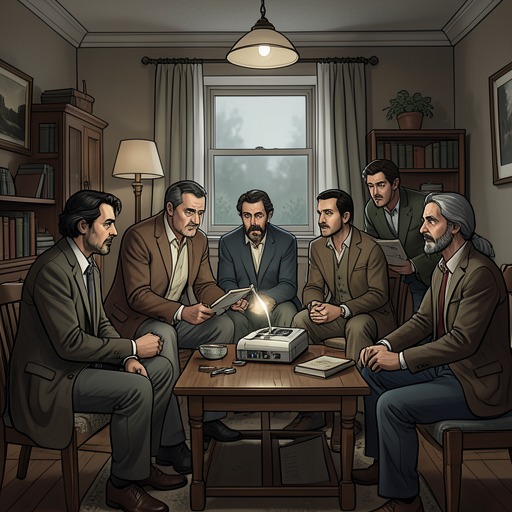
The later examination of the evidence identifies the missing Dictaphone as a crucial complication. Poirot reasons that a person who knew Ackroyd had acquired the machine, had the mechanical knowledge to use or arrange it, could take the dagger before Flora arrived, and had a suitable bag could also have had an opportunity in the study after the crime was discovered. Davis’s initial focus on Ralph does not account for this chain of requirements. The contrast makes Davis important not as the final interpreter of the case, but as the investigator whose premature reconstruction helps reveal why the clues must be reconsidered.